5 Real-World SOP Examples Every Service-Based Business Needs to Scale
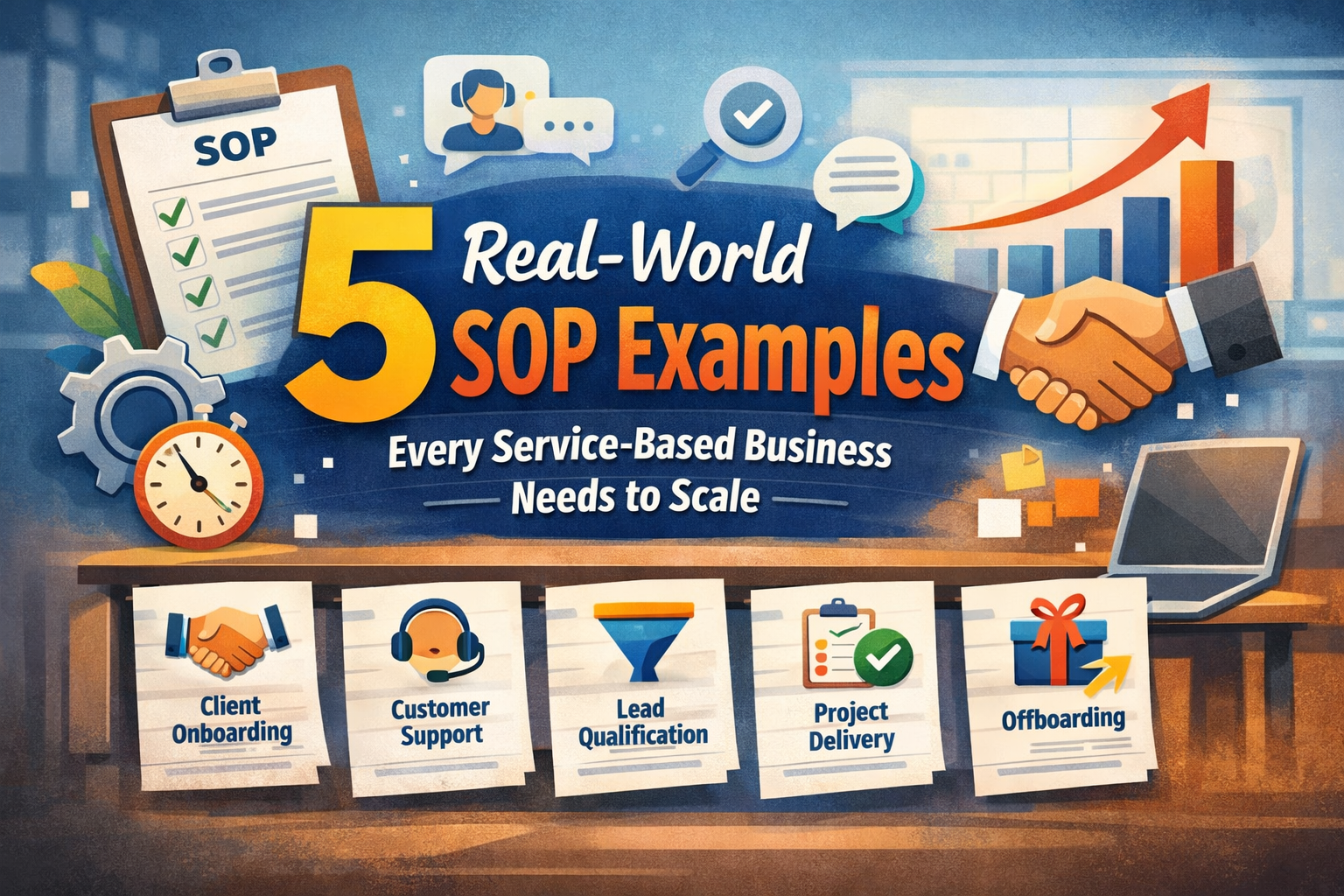
5 Real-World SOP Examples Every Service-Based Business Needs to Scale
Scaling a service-based business is notoriously difficult because, unlike software, your "product" is human effort. Without clear guidelines, growth usually leads to chaos, burnout, and a decline in quality.
Standard Operating Procedures (SOPs)—or Procedimentos Operacionais Padrão (POP)—are the blueprints that allow your team to deliver consistent results without you being involved in every decision.
Here are five real-world SOP examples that every service-based business needs to implement to move from "freelancer mode" to a scalable agency or consultancy.
1. Client Onboarding SOP
The first impression is everything. A client onboarding SOP ensures that as soon as a contract is signed, the client feels taken care of and your team has everything they need to start.
What to include:
- Automatic trigger for the Welcome Email.
- Link to a kickoff questionnaire.
- Internal checklist for setting up project management folders (Drive, Slack, Trello).
- Schedule for the kickoff call.
2. Customer Support & Communication (POP para Atendimento ao Cliente)
In service businesses, communication is the product. Having a structured approach to customer service ensures no balls are dropped and clients feel heard.
What to include:
- Response Time Standards: Goals for replying to emails (e.g., within 24 business hours).
- Tone of Voice Guidelines: How to handle difficult questions or scope creep.
- Escalation Path: When a team member should move a ticket to a manager.
- Standard Templates: Pre-written responses for common inquiries.
3. The Lead Intake & Qualification SOP
Stop wasting time on "coffee chats" with people who can't afford you. A qualification SOP filters leads before they ever reach your calendar.
What to include:
- Specific criteria for a "Good Fit" client.
- A scoring system based on budget, timeline, and need.
- Automated "Not a Fit" email templates that point rejected leads toward helpful resources.
4. Project Delivery/Execution SOP
This is the core of your business. If you are a graphic design agency, this is your design process. If you are a consultancy, this is your audit process.
What to include:
- Step-by-step technical instructions.
- Quality assurance (QA) checklists (e.g., "Check all links," "Verify color codes").
- Software tools to be used at each stage.
- Definition of "Done" for the project.
5. Offboarding & Referral Request SOP
Most businesses stop when the work is delivered. A scalable business uses the end of a project to fuel the start of the next one.
What to include:
- Final delivery checklist (handing over assets/credentials).
- A "Thank You" gift or note protocol.
- The Feedback Survey (to gather testimonials).
- A scheduled follow-up email 30 days later to ask for a referral.
Conclusion
SOPs are not meant to be rigid "rules" that stifle creativity; they are the floor that prevents your quality from falling. By documenting these five areas, you transition from a business that relies on your constant presence to one that can grow independently.
Start today: Pick the one process that causes the most "fires" in your business this week and write down the five steps to fix it. That is your first SOP.