Kellogg Innovation Network (KIN): The Global Innovation Hub Reshaping How Leaders Solve Big Problems
Meta Description: Discover the Kellogg Innovation Network (KIN) — a global platform connecting executives, academics & innovators at Northwestern University to solve complex challenges. (158 characters)
Kellogg Innovation Network (KIN): The Global Innovation Hub Reshaping How Leaders Solve Big Problems
What if the world's most pressing business challenges — climate disruption, healthcare transformation, economic inequality — could be addressed not in boardrooms alone, but through structured, cross-sector dialogue between executives, academics, policymakers, and artists? That's precisely what the Kellogg Innovation Network (KIN) was built to do.
Rooted in Northwestern University's Kellogg School of Management, KIN has been quietly reshaping global innovation leadership since 2003. If you're an executive, entrepreneur, researcher, or innovation strategist who hasn't fully explored what this network offers, you're likely leaving significant strategic value on the table.
What Is the Kellogg Innovation Network?
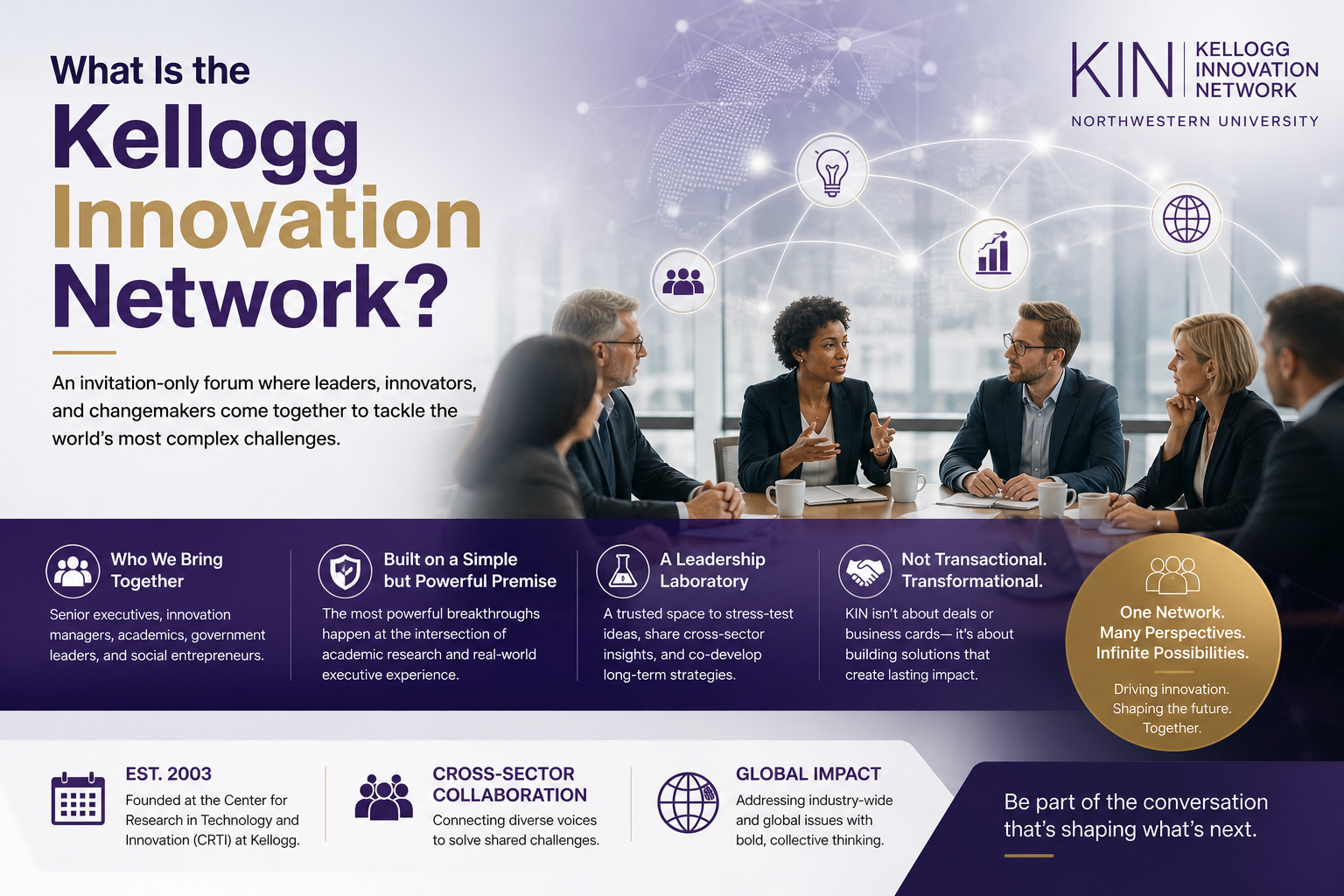
The Kellogg Innovation Network, commonly referred to as KIN, is a unique, invitation-only forum that brings together senior executives, innovation managers, academics, government leaders, and social entrepreneurs to tackle industry-wide and global challenges.
Founded in 2003 at the Center for Research in Technology and Innovation (CRTI) at Northwestern University's Kellogg School of Management, KIN was built on a deceptively simple premise: the most powerful breakthroughs happen at the intersection of rigorous academic research and real-world executive experience.
Unlike traditional industry associations or alumni networks, KIN is not transactional. It's not about closing deals or collecting business cards. It functions as what one might call a "leadership laboratory" — a trusted space where ideas are stress-tested, cross-sector insights are shared, and long-term strategies are co-developed without the pressures of competitive positioning.
Key fact: KIN initiatives directly contribute to solving challenges facing innovation leaders today, while simultaneously enabling academics to define relevant, timely issues for future research.
The Origins and Mission of KIN
KIN was founded by Robert C. Wolcott, a professor at the Kellogg School of Management and a specialist in entrepreneurship and innovation. From its inception, the network was structured around a dual mission:
- Practitioners informing research — Real-world executives share challenges that guide academic inquiry
- Research informing practice — Academic findings are translated into actionable frameworks for business leaders
This bidirectional flow of knowledge is what makes KIN unusual in the landscape of executive education and professional networks. Most organizations transfer knowledge in one direction. KIN creates a dynamic ecosystem where insight flows both ways, making it more valuable over time for everyone involved.
The founding philosophy also recognized something that many organizations miss: complex global challenges are inherently cross-disciplinary. You cannot solve healthcare innovation with only doctors in the room. You cannot address urban sustainability without input from technologists, city planners, behavioral scientists, and business strategists. KIN was designed to break down those silos from day one.
Who Participates in the Kellogg Innovation Network?
KIN draws an exceptionally diverse and senior membership. Participants have included:
- C-suite executives from global corporations (Fortune 500 and beyond)
- Senior government officials, including former heads of state and senior advisors to world leaders
- Academic researchers from Kellogg and peer institutions
- Nonprofit founders and social impact entrepreneurs
- Technology investors and venture capitalists
- Artists and cultural leaders who bring unconventional perspectives to complex problems
Past KIN Global Summits have attracted delegates such as former presidents and prime ministerial advisors, the CEO and chairman of Zurich Insurance Group, senior leaders from SAP, and founders of organizations like Susan G. Komen — representing participants from 29 countries across every continent.
This breadth of participation is not accidental. It is architectural. KIN deliberately builds in cognitive diversity because the network understands that breakthrough thinking rarely comes from within a single discipline or sector.
KIN's Flagship Programs and Events
The KIN Global Summit
At the heart of the Kellogg Innovation Network is its annual KIN Global Summit — a multi-day immersive gathering that draws hundreds of thought leaders from around the world. Unlike conventional conferences, the KIN Global Summit is structured around dialogue, collaboration, and long-term thinking rather than one-way presentations.
Past summit themes have explored topics including:
- Feeding the World: The Future of Agriculture
- Healing the Healthcare Ecosystem
- The Future of Work and Economic Transformation
- Artificial Intelligence, Ethics, and Society
- Climate Innovation and Environmental Sustainability
Sessions are deliberately designed to create serendipitous collisions between disciplines — where a technology entrepreneur might find themselves in deep conversation with a healthcare researcher, or a business executive discovers a new strategic approach through dialogue with a social impact leader.
KIN Catalyst Forums
Beyond the annual summit, KIN hosts KIN Catalyst Forums — smaller, more focused gatherings designed to accelerate innovation dialogue in specific industries or around specific challenges. These forums allow for deeper dives than the broader Global Summit permits, making them particularly valuable for innovation leaders who want to move from conversation to action.
KIN Expeditions
One of KIN's most distinctive programs, KIN Expeditions take members directly to the world's leading innovation ecosystems. Launched with a 2012 visit to Panama, KIN Expeditions have included a celebrated visit to Israel's startup ecosystem — famously dubbed "Start-up Nation" — where delegates from companies like Walmart, Sony, and Crate & Barrel explored first-hand how Israel's universities, government agencies, and venture capital firms collaborate to produce world-class innovation at scale.
These on-the-ground experiences offer something no conference or case study can replicate: direct exposure to how different cultures approach innovation, and the professional relationships that emerge from shared learning in new environments.
The Kellogg Technology Summit (KTS)
A complementary initiative under the KIN umbrella, the Kellogg Technology Summit (KTS) is a global, cross-industry knowledge exchange for IT executives. It focuses specifically on technology management and strategy, operating under a confidential, collaborative model that allows participants to engage candidly about challenges they can't discuss in public forums. The KTS also produces frameworks and best practices used by both academic researchers and business practitioners.
KIN's Connection to the Northwestern Innovation Institute
KIN's work has helped lay the intellectual groundwork for Kellogg's broader innovation research agenda. This is most evident in the recently established Northwestern Innovation Institute (NI Institute) — a bold, $25 million initiative funded by the Future Wanxiang Foundation. The NI Institute uses big data analytics, artificial intelligence, and physics-based mathematical models to decode how scientific breakthroughs emerge and spread.
At its core is TechBridge, a data collaboration network connecting over 25 leading universities, allowing institutions to share previously siloed data about research activities, patents, grants, and innovation outcomes. This represents the next frontier of what KIN has always championed: using structured collaboration to accelerate the pace and quality of innovation at a systemic level.
Why the Kellogg Innovation Network Matters More Than Ever
In an era defined by compounding complexity, the value of networks like KIN is not just theoretical — it is strategic.
Consider what the modern innovation leader faces:
- Technological disruption is outpacing traditional strategic planning cycles
- Global challenges like climate change and public health crises demand cross-sector responses
- AI and automation are reshaping entire industries faster than most organizations can adapt
- Geopolitical volatility creates new risks and unexpected opportunities simultaneously
The Kellogg Innovation Network addresses each of these pressures by equipping leaders with something that data and algorithms alone cannot provide: the wisdom that emerges from trusted, diverse human dialogue. Membership in KIN means access to a community of peers who have navigated similar challenges — and an academic anchor at one of the world's top business schools ensuring that conversations are grounded in evidence, not just anecdote.
Real-World Impact: What KIN Members Take Away
Participation in the Kellogg Innovation Network delivers tangible value at multiple levels:
- Strategic insight — Exposure to ideas and approaches from outside your industry can directly inform competitive strategy
- Cross-sector partnerships — Many significant collaborations have originated at KIN events, connecting companies, nonprofits, and government bodies that would never have intersected otherwise
- Research access — Members benefit from direct engagement with Kellogg's world-class faculty and cutting-edge academic research
- Global perspective — By engaging leaders from 29+ countries, KIN ensures members understand innovation not as a single model but as a diverse, culturally shaped practice
- Personal development — The reflective, long-horizon conversations that KIN facilitates help senior leaders develop the kind of adaptive thinking that defines great leadership
Frequently Asked Questions About the Kellogg Innovation Network
1. How is the Kellogg Innovation Network different from regular executive education programs?
KIN is not a curriculum-based executive education program. It is a peer community and knowledge-exchange network where senior executives and academics engage as equals. There are no grades, no credentials — only collaborative problem-solving and strategic dialogue. Think of it as a trusted advisory ecosystem rather than a course.
2. Is the Kellogg Innovation Network open to anyone?
KIN has historically been described as an invitation-only community. Membership is selective and curated to maintain the quality and diversity of discourse. That said, the KIN Global Summit has opened certain sessions to the broader Northwestern University and Kellogg alumni community, providing a pathway for emerging leaders to engage with the network.
3. What industries does KIN serve?
KIN is deliberately cross-industry. Past participants have come from technology, healthcare, financial services, consumer goods, energy, government, defense, non-profit, media, and the arts. This breadth is a core design feature, not a coincidence — the network believes that the most important innovation insights are often cross-sector transfers of ideas and practices.
4. How does KIN relate to the broader Kellogg School of Management?
KIN is housed within the Center for Research in Technology and Innovation (CRTI) at the Kellogg School of Management at Northwestern University. It is closely connected to Kellogg's broader ecosystem of innovation initiatives, including the Kellogg Innovation & Entrepreneurship Initiative (KIEI) and the newly established Northwestern Innovation Institute.
5. What is the KIN Global Summit and how can I get involved?
The KIN Global Summit is KIN's flagship annual event, gathering hundreds of global leaders for three days of structured dialogue and collaboration. Interested participants — particularly those from the Northwestern and Kellogg alumni communities — can watch for open session registrations, which are periodically made available. Following KIN through Kellogg's official channels is the best way to stay informed.
Conclusion: Why You Should Be Paying Attention to the Kellogg Innovation Network
The Kellogg Innovation Network occupies a rare space in the global innovation landscape — one where rigorous academic thinking meets senior executive practice, where disciplinary boundaries dissolve in service of big-picture problem solving, and where long-term relationships replace transactional networking.
In a world where innovation is increasingly treated as a function to be managed rather than a culture to be cultivated, KIN stands as a powerful counterpoint. It reminds us that the best ideas rarely come from within a single silo, and that the most durable solutions are built through trust, diversity, and sustained dialogue.
Whether you are a senior executive navigating disruption, an academic researcher seeking real-world relevance, or an entrepreneur looking to connect with the highest tier of global innovation leadership — the Kellogg Innovation Network represents one of the most credible and high-impact communities you can engage with.
Ready to go deeper? Explore the Kellogg School of Management's CRTI page for the latest on KIN programs, or visit the Northwestern Innovation Institute to see how Kellogg is pioneering the science of innovation itself.
Internal Linking Suggestions
- "What Is the Kellogg School of Management?" — Link to an overview post on Kellogg's rankings, programs, and reputation
- "Best Executive MBA Programs for Innovation Leaders" — Connect readers exploring KIN to related MBA options
- "Top Global Innovation Conferences to Attend" — Position KIN Global alongside peer events like Davos, TED, and SXSW
- "Northwestern University's Innovation Ecosystem" — Explore KIEI, NI Institute, and other Northwestern innovation initiatives
External Authority References
- Kellogg School of Management – CRTI
- Northwestern Innovation Institute
- Northwestern University Innovation Overview
Word count: ~1,650 words | Primary keyword: "Kellogg Innovation Network" | LSI keywords used: KIN, Northwestern University, Kellogg School of Management, CRTI, KIN Global Summit, innovation leadership, cross-sector collaboration, executive network, innovation ecosystem, corporate innovation strategy